DoubleTT and categorical logic
CatColab [1] is a collaborative modelling platform based on categorical logic.
DoubleTT [2] is a component of CatColab which facilitates model composition using a type theory for models of double theories.
The theory for a particular logic defines the “shape” of its models. Formally:
- a theory is a fibrational VDC (possibly unital, possibly with loose composites) equipped with zero or more double monads, called modalities.
- a model \(M\) of a theory \(\mathbb{T}\) is a restriction-preserving functor \[M : \mathbb{T} \to \mathbb{S}\mathrm{pan}\]
DoubleTT and categorical logic
Example: the theory of categories is a unital VDC with a single object and no (nonunital) tight/loose arrows.
Example: the theory of monoidal categories is a unital VDC, equipped with “the” list monad \(\mathrm{List}\), generated by an object \(X\) and a tight morphism \[\otimes: \mathrm{List}(X) \to X\] (These are equipped with the usual axioms making \(\otimes\) a monoidal product.)
DoubleTT and categorical logic
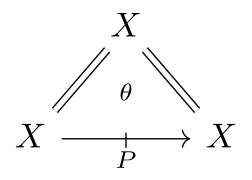
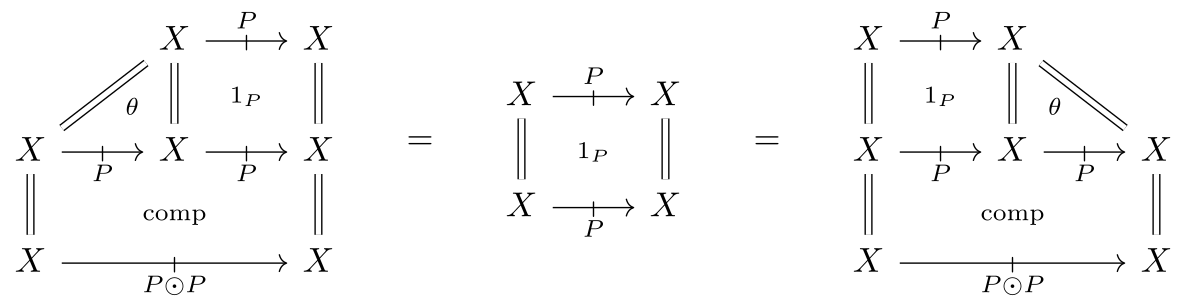
Example: the theory of promonads is a unital VDC with an object \(X\), a proarrow \(P : X \mathrel{\mkern 3mu\vcenter{\hbox{$\scriptstyle+$}}\mkern-13mu{\to}}X\) such that the loose composite \(P \odot P\) is defined and is equal to \(P\), and a virtual cell \(\theta\):
![]()
such that the cell equalities below are satisfied:
![]()
Specifying custom theories
Currently the theories available in DoubleTT are constructed directly in Rust, rather than a dedicated language. Users are limited to a small handful of pre-defined options unless they manually introduce their own using CatColab’s internal data structures.
Goal: allow the user to easily define their favorite theory in a small DSL by
- specifying a signature (generators)
- specifying axioms (relations)
- with a guarantee that the DSL only accepts theories which are well-defined (without requiring any internal consistency checks later).
Specifying custom theories
Idea: annotate the user-specified theory with types, such that a theory which successfully typechecks is always valid.
Observation: user-defined axioms can equate any pair of cells with the same boundary, so this amounts to a type theory for the internal language of VDCs.
Remark: as we saw for the theory of promonads, theories may also equate (pro)arrows, so even checking compatibility of cell boundaries is nontrivial.
An internal logic of VDCs
Hayato Nasu’s past work [3] on a type theory for (fibrational, cartesian) VDCs guided the early stages of this project.
Idea: describe a pointful syntax [2,4] for the constructs in a VDC, which reduces equivalent (via universal property) structures to a single normal form.
An internal logic of VDCs
The correspondence between constructs in a VDC and the syntax of Nasu’s type theory is outlined below:
| Object |
Type |
\(X \Leftrightarrow X \text{ type}\) |
| Product |
Context |
\(\prod_{i=1}^n X_i \Leftrightarrow x_1 : X_1, \dots, x_n : X_n \text{ ctx}\) |
| Morphism |
Term |
\(s : \Gamma \to X \Leftrightarrow \Gamma \vdash s : X\) |
| Proarrow |
Protype |
\(P :\Gamma \mathrel{\mkern 3mu\vcenter{\hbox{$\scriptstyle+$}}\mkern-13mu{\to}}\Delta \Leftrightarrow \Gamma ; \Delta \vdash P(s ; t) \text{ protype}\) |
| Proarrow path |
Procontext |
\(\Gamma_0 \mathrel{\mkern 3mu\vcenter{\hbox{$\scriptstyle+$}}\mkern-13mu{\to}}\Gamma_1 \mathrel{\mkern 3mu\vcenter{\hbox{$\scriptstyle+$}}\mkern-13mu{\to}}\cdots \mathrel{\mkern 3mu\vcenter{\hbox{$\scriptstyle+$}}\mkern-13mu{\to}}\Gamma_n \Leftrightarrow \rho_1 : P_1, \dots, \rho_n : P_n \text{ proctx}\) |
| (Globular) Cell |
Proterm |
\(\mu : P_1, \dots, P_n \mathrel{\mkern 3mu\vcenter{\hbox{$\scriptstyle+$}}\mkern-13mu{\to}}Q \Leftrightarrow \Gamma_0 ; \dots ; \Gamma_n \vert \rho_1 : P_1, \dots, \rho_n : P_n \vdash \mu : Q\) |
An internal logic of VDCs
Example
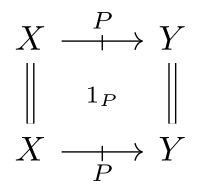
The (tight) identity cell
![]()
…is represented by the proterm
\[x : X, y : Y \vert p : P(x ; y) \vdash p : P(x ; y)\]
An internal logic of VDCs
Example
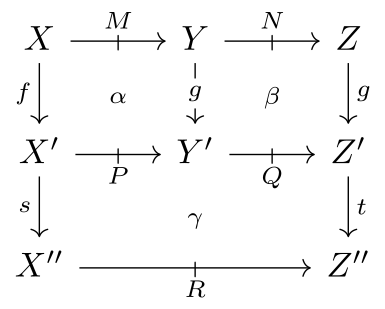
The virtual composite cell
![]()
…is represented by the proterm
\[
\begin{aligned}
x : X, y : Y, z : Z \vert m : M(x ; y), n : N(y; z) \vdash\\
\gamma (\alpha(m), \beta(n)): R(s(f(x)) ; t(g(z)))
\end{aligned}
\]
An internal logic of VDCs
Restrictions
For this type theory to model the internal language of fibrational VDCs it needs to capture restriction cells and their universal property.
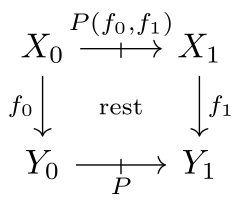
Given a proarrow \(P : Y_0 \mathrel{\mkern 3mu\vcenter{\hbox{$\scriptstyle+$}}\mkern-13mu{\to}}Y_1\) and tight morphisms \(f_i : X_i \to Y_i\), the protype \[
x_0 : X_0 ; x_1 : X_1 \vdash P(f_0(x_0), f_1(x_1))
\] represents the restriction of \(P\) along \(f_0\) and \(f_1\).
An internal logic of VDCs
Restrictions
We recover the corresponding restriction cell
![]()
with the proterm \[
x_0 : X_0, x_1 : X_1 \vert p : P(f_0(x_0), f_1(x_1)) \vdash p : P(f_0(x_0), f_1(x_1)),
\] since the tight identity cell of a restriction proarrow corresponds uniquely with the restriction cell via the universal property.
An internal logic of VDCs
(Loose) Composition
The type theory can be extended with type formation, introduction, and elimination rules for loose composites.
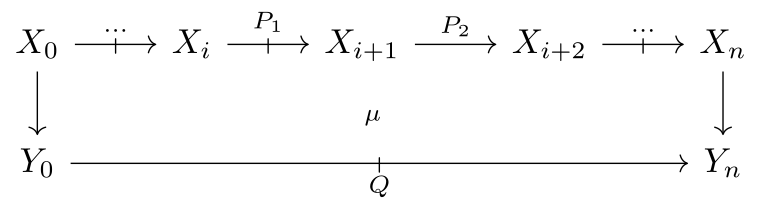
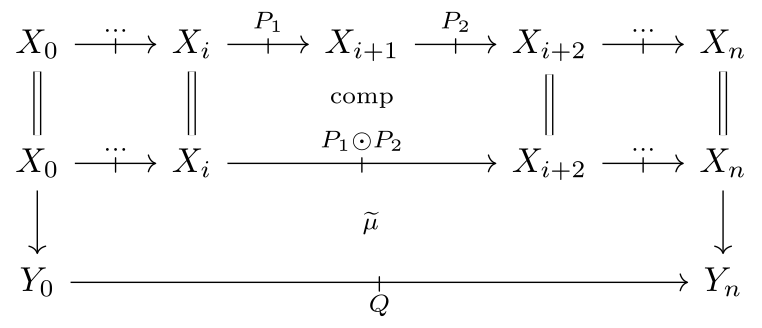
The universal property for composites says that each cell \(\mu\) induces a unique \(\widetilde{\mu}\) such that
![]()
An internal logic of VDCs
(Loose) Composition
The type theory can be extended with type formation, introduction, and elimination rules for loose composites.
…is equal to the virtual composite
![]()
An internal logic of VDCs
(Loose) Composition
Like restriction, we encode the universal property in the internal language using a normal form.
Namely, the \(\beta\)/\(\eta\)-reduction rules (judgments relating a type’s constructor(s) and eliminator(s)) for composites precisely capture this universal property.
An internal logic of VDCs
Extensions
Nasu’s type theory offers a strong foundation, but it lacks some characteristics that are important to our use case:
- Rigid signature: generator cells cannot map into a restriction or unit proarrow, for instance.
- Missing modalities: virtual double monads are not supported by the type theory, which are essential for defining many important doctrines.
- Challenging to implement: the type theory is not designed with algorithmic typechecking in mind.
ModalTT
Type theory
We adapt Nasu’s type theory by introducing modalities and broadening the expressive power of the generator symbols.
To match the implementation, we also rely less heavily on substitution (which is badly behaved in the presence of non-syntactic equalities.)
ModalTT
Signature
The signature \(\Sigma\) determines the structures of a theory \(\mathbb{T}_\Sigma\) by specifying finite sets of generators:
Object symbols \(\mathcal{T}_\Sigma\)
Arrow symbols \(\mathcal{F}_\Sigma\)
Proarrow symbols \(\mathcal{P}_\Sigma\)
Cell symbols \(\mathcal{C}_\Sigma\)
Modality symbols \(\mathcal{M}_\Sigma\)
ModalTT
Signature
These generator symbols are closed under modal application (the sets of arrows and cells are also populated with the monad structure for each \(L \in \mathcal{M}_\Sigma\)).
The complete sets of arrows (resp. proarrows) are then generated from the modal closures by including identities (resp. loose units) and composites (resp. loose composites).
ModalTT
Typing Judgments
\[
\begin{aligned}
\text{Type} & ::= X \text{ type}\\
\text{Context} & ::= \Gamma \text{ ctx}\\
\text{Term} & ::= \Gamma \vdash s : X\\
\text{Protype} & ::= \Gamma_0 ; \Gamma_1 \vdash P \text{ protype}\\
\text{Procontext} & ::= \Gamma_0 , \dots , \Gamma_n \vert \Omega \text{ proctx}\\
\text{Proterm} & ::= \Gamma_0, \dots, \Gamma_n \vert \Omega \vdash \mu : P
\end{aligned}
\]
ModalTT
Types
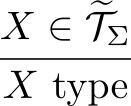
A type is (just) an object generated by the signature:
![]()
ModalTT
Term Contexts: Grammar
\[
\begin{aligned}
x &\in \mathrm{Var}_{\mathrm{Type}}\\
X &\in \widetilde{\mathcal{T}}_\Sigma\\
\Gamma &\in \mathrm{Context} ::= (x : X)
\end{aligned}
\]
Note: our theories are not necessarily cartesian, so our (term) contexts are unary [4], containing a single variable binding.
ModalTT
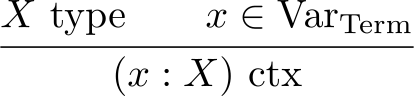
Term Contexts: Typing Judgment
![]()
ModalTT
Terms: Grammar
\[
\begin{aligned}
x &\in \mathrm{Var}_\mathrm{Term}\\
f &\in \widetilde{F}_\Sigma\\
s &\in \mathrm{Term} ::= x \vert f(s)
\end{aligned}
\]
ModalTT
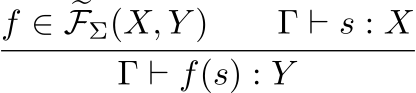
Terms: Typing Judgments
![]()
![]()
ModalTT
Terms: Substitution
Terms are equipped with a meta-theoretic variable substitution, defined in the obvious way:
\[
t[s/x] := \begin{cases}
s & \text{if } t = x\\
f(t'[s/x]) & \text{if } t = f(t')
\end{cases}
\]
(As usual, we assume that \(x\) is not a variable in \(s\) to avoid variable capture.)
ModalTT
Protypes: Grammar
\[
\begin{aligned}
s_0, s_1 & \in \mathrm{Term}\\
P & \in \hat{\mathcal{P}}_\Sigma\\
\underline{P} &\in \mathrm{Protype} ::= P(s_0, s_1)
\end{aligned}
\]
ModalTT
Protypes: Typing Judgments
![]()
![]()
![]()
ModalTT
Procontexts: Grammar
For \(n \geq 0\): \[
\begin{aligned}
\Gamma_i &\in \mathrm{Context}\\
\underline{P_i} &\in \mathrm{Protype}\\
p_i &\in \mathrm{Var}_\mathrm{Proterm}\\
\overline{\Gamma} \vert \Omega &\in \mathrm{Procontext} ::= \Gamma_0, \dots, \Gamma_n \vert p_1 : \underline{P_1}, \dots, p_n : \underline{P_n}
\end{aligned}
\]
Note: both components of our procontexts are ordered (in the sense of ordered linear1 logic [5,6]).
ModalTT
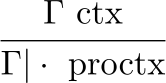
Procontexts: Typing Judgments
![]()
![]()
ModalTT
Proterms: Grammar
\[
\begin{aligned}
p_i &\in \mathrm{Var}_\mathrm{Proterm}\\
f, g &\in \hat{\mathcal{F}}_\Sigma \\
s_i &\in \mathrm{Term} \\
\alpha &\in \hat{C}_\Sigma(P_1, \dots, P_n \Rightarrow Q \vert f \to g)\\
\mu &\in \mathrm{Proterm} \\
&::= p \\
&\hspace{0.5em}\vert \alpha \langle s_0, \dots, s_n \rangle (\mu_1, \dots, \mu_n) \\
&\hspace{0.5em}\vert \mu_1 \odot \mu_2\\
&\hspace{0.5em}\vert \text{let } [p_1 : \underline{P_1}, p_2 : \underline{P_2}] = \mu_1 \text{ in } \mu_2\\
\end{aligned}
\]
ModalTT
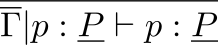
Proterms: Typing Judgments
![]()
![]()
ModalTT
Proterms: Typing Judgments
![]()
![]()
ModalTT
VDC Semantics
Note: the underlying VDC semantics of the type theory is still a work-in-progress.
We define a modal, fibrational VDC (with composites) \([\![ \mathbb{T}_\Sigma ]\!]\) as follows:
- Objects are term contexts \(\Gamma = (x : X)\) (these are effectively just types annotated with a variable) modulo alpha equivalence of variables.
- Tight morphisms \((x : X) \to (y : Y)\) are terms \((x : X) \vdash s : Y.\)
- Proarrows \((x : X) \mathrel{\mkern 3mu\vcenter{\hbox{$\scriptstyle+$}}\mkern-13mu{\to}}(y : Y)\) are protypes \[
(x : X) ; (y : Y) \vdash P(s, t).
\]
ModalTT
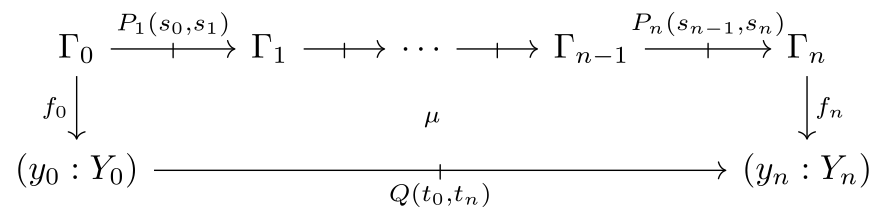
VDC Semantics
![]()
are proterms \[
\begin{aligned}
\Gamma_0, \dots, \Gamma_n \vert p_1 : P_1(s_0, s_1), \dots, p_n : P_n(s_{n-1}, s_n) \vdash\\
\mu : Q(t_0[f_0(s_0)/y_0], t_n[f_n(s_n)/y_n]).
\end{aligned}
\]
ModalTT
VDC Semantics
- Restriction cells are obtained via term substitution: \[
x_0 : X_0, x_1 : X_1 \vert p : P(f_0(x_0), f_1(x_1)) \vdash p : P(f_0(x_0), f_1(x_1))
\]
- Loose composition is precisely \(\odot\)-introduction on protypes and proterms, with the universal property supplied by \(\odot\)-elimination along with the \(\beta\)/\(\eta\)-computation rules (not shown).
- Each modality symbol \(L \in \mathcal{M}_\Sigma\) corresponds to a monad on \([\![\mathbb{T}_\Sigma]\!]\) via the derived form \(L[-]\) and the primitive structure morphisms/cells \(\eta\) and \(\mu\). Functoriality is immediate from the normal form.
Future work
- Typing judgments for loose units are subtle and not fully developed (hence their omission). As currently implemented, they lack a normal form.
- The expected metatheorems (cut elimination, soundness of the VDC semantics, etc.) need to be checked more carefully. The semantics themselves are also not yet fully complete.
- The surface syntax is cumbersome and not especially user-friendly.
- The internal representation still needs to be hooked up to CatColab so that the DSL can actually be used alongside DoubleTT models.